






Only a few weeks ago, the Shadow Powers Times spoke to Ray Adam about his new novel »The Animals of Troyes«. At the time, the French edition was expected by Christmas and the English one the following spring. The novel now exists in five languages. And just as his animals are learning to speak to more and more of the world, the author has become preoccupied with a rather different question: Can our children still read?
In September, the Shadow Powers Times visited writer Ray Adam to talk about an unusual novel. »The Animals of Troyes« is set more than 11,000 years after the end of humanity. Canids, horses, mice, eagles and other animal peoples have built a new civilisation - more peaceful than the one that came before them.
Until one day Gaïa falls silent and neighbours become adversaries.
At the time, only the German edition had just been published.
Adam spoke about the years it took to create the novel, about a story that had originally grown out of political ideas, and about his plan to make Troyes accessible to readers beyond Germany. The French version, he said then, might perhaps be finished before Christmas. English was to follow in the spring.
A remarkably cautious timetable, as it turned out. Only a few weeks later, »The Animals of Troyes« is no longer available in German alone. The novel has now been completed in five languages. Reason enough for the Shadow Powers Times to ask a few more questions.
SPT: Mr Adam, when we spoke in September, your timetable sounded almost suspiciously sensible. French by Christmas, English perhaps in the spring. What happened?
Ray Adam: I probably should have stuck to my own timetable. I would have slept rather more over the past few weeks. [ laughs ] But at some point the French version was finished - and then I wanted to know whether the next one would work just as well. And eventually you look at the clock and realise: it is five in the morning.
SPT: German, English, French, Spanish - and Latin. We can follow you through the first four. But why on earth Latin?Ray Adam: Because I wanted to know whether it could be done, and whether I could still do it well enough. And because Latin is not a dead language to me. For centuries it was a language in which stories, history, philosophy and knowledge were passed on. Besides, I liked the idea. Here I am writing a novel about a world in which human civilisation has been gone for 11,000 years - and these animals, of all creatures, tell their story in the language of the ancient Romans as well. I simply liked that thought.
SPT: Was this really translation? Or did artificial intelligence press the same button five times?
Ray Adam: If it had been that easy, I really would have slept more. [ laughs ] Of course AI played a supporting and checking role in the translations. But literary translation is not a matter of replacing German sentences with foreign ones. Characters have voices. A joke has to work. A sentence can be grammatically impeccable and still be completely wrong for the character. Sometimes you only discover after several versions that a phrase says exactly the same thing - but does not tell the same thing.
SPT: So you treated every version as a novel in its own right?
Ray Adam: Exactly. The story was not allowed to change, but it had to come alive again in another language. Dunny has to remain Dunny. Sammy has to remain Sammy. Humour has to remain humour, sadness has to remain sadness. Latin was a particular challenge, because you cannot simply pretend that the ancient world always had a convenient word for ours. At the same time, I did not want artificial classroom Latin. The animals of Troyes had to be alive in Latin too.
SPT: Why go to all that trouble? For an independent author, surely it would have been far easier to publish the German book and wait to see whether anyone bought it.
Ray Adam: Because something else interests me more than how many copies I sell in which country. To me, a story only really exists when somebody reads it. And if I can open the same door into Troyes for a French, Spanish or English-speaking reader that I can open for a German reader, then I want to try.
SPT: That sounds almost as if a book project has quietly turned into an international educational project.
Ray Adam: That was never the plan, but perhaps that is what it has become.
SPT: How did that happen?
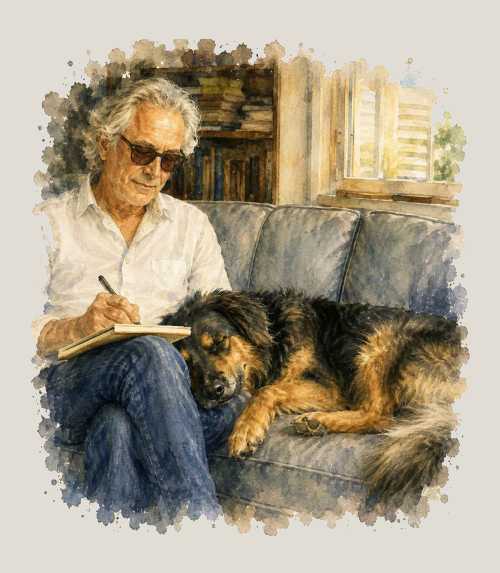
Ray Adam © 2026
Ray Adam: Through my Dunny, who accompanies every word I write. We developed a small reading campaign for »The Animals of Troyes« and made him an »Ambassador for Reading«. At first it was simply a nice idea connected with the book. But the longer I thought about it, the less harmless the question behind it began to seem.
SPT: Which question?
Ray Adam: What we actually mean today when we say that somebody can read.
SPT: That sounds fairly unambiguous.
Ray Adam: I used to think so too, until many years ago I began noticing something in my own children and their circle of friends. They had grown up with mobile phones and digital communication and of course they could read. In fact, they were reading constantly: messages, short texts, adverts, later social media. But increasingly I had the impression that today we use the word »reading« for two different abilities.
SPT: You distinguish between two kinds of reading?
Ray Adam:
Yes. As someone who studied German language and literature and trained as an educator, I eventually began, for my own purposes, to distinguish between two different forms of reading:
READING-1 is reading for meaning - the classical form of reading we used to mean when we spoke of reading. It means that the reader does not merely decode the words on a page, but grasps the meaning of the text, follows a train of thought across sentences and paragraphs, connects information and understands what is stated explicitly - and sometimes what is not stated at all.
READING-2 is something quite different. Words, short statements and their immediate meaning can be grasped rapidly, often at a glance. Images, symbols and emojis supply additional clues. That is complex communication, and it can be astonishingly efficient, but it works through a very different process of reception and does not demand the same intellectual effort as genuine READING-1.
SPT: So the smartphone is not actually the villain of your campaign?
Ray Adam: No. The smartphone itself is only a piece of technology, one that even very young children now carry around as if it were the most natural thing in the world. But the way smartphones have changed communication across the globe - that increasingly worries me.
SPT: We seem to have travelled rather a long way from an adult novel about talking animals.
Ray Adam: Not necessarily.
SPT: Why not?
Ray Adam:
Because at its core »The Animals of Troyes« is about precisely the problem we have just described:
What happens to a society when mutual understanding breaks down? Gaïa connects the peoples of Troyes. When that connection suddenly falls silent, reason and decency do not vanish overnight, but uncertainty takes hold. Rumours spread, mistrust grows, and the animals increasingly begin to question agreements with other species that have stood for thousands of years.
SPT: You see a parallel with our own society?
Ray Adam: Absolutely. Except that our communication has not fallen silent. Quite the opposite: we probably communicate more than ever before. What I increasingly wonder is whether that means we understand one another any better.
SPT: This is beginning to sound like the standard indictment of smartphones and social media: once people read books, now they watch TikTok. Isn't that a little too easy?
Ray Adam: Far too easy, which is precisely why that is not my argument. I am not an opponent of digital communication. Without it, I could not write, translate, publish and make my books internationally accessible in the way I do today. I draw a very sharp distinction between digital technology and what we now call »social media«.
SPT: You don't seem terribly fond of social media.
Ray Adam: That is putting it politely. I regard most of these so-called social media as profoundly antisocial, and I regard their present form as a serious danger to democratic societies everywhere in the world.
SPT: That is a very large claim.
Ray Adam: Yes. Which is why it needs to be discussed. Democracy assumes that people can take in different kinds of information, test arguments, tolerate contradiction and eventually arrive at a judgement of their own. And that brings us straight back to my READING-1.
SPT: Because politics refuses to fit neatly into three sentences?
Ray Adam: Exactly. A complicated problem remains complicated even when you cut it down to fifteen seconds of video. You have not simplified it - you have merely stripped pieces away until all that remains are slogans, images and emoticons.
SPT: Yet social networks can also make political participation easier: people circulate information, expose abuses, organise themselves and communicate directly with one another.
Ray Adam: I do not dispute that for a moment. Never before has it been so easy for people to publish information and share it with others. My concern begins when information is no longer competing for attention, but attention itself has become the business model.
SPT: What has any of that got to do with reading?
Ray Adam: A great deal. If a medium survives by making me react as quickly as possible to the next piece of content, it rewards a completely different form of perception from a longer text:
That is my READING-2. But at crucial moments democracy needs READING-1: stop, grasp the connections, compare sources, notice a contradiction - and sometimes, after ten minutes, discover that your first opinion may have been wrong.
SPT: So your reading campaign has become a political campaign after all?
Ray Adam: No! Absolutely not! Dunny is not supposed to tell anyone what to think. It is exactly the opposite: Dunny is arguing that people should preserve the ability to think for themselves - despite the technology most of us spend hours tapping at every day. And for me, reading for meaning is unquestionably part of that.
SPT:
And that is why your campaign says
Ray Adam: Exactly. And the line is deliberately a little cheeky. Of course I know that you can read a real book on a tablet or an e-reader. This is not paper versus screen. It is about the kind of reading we do. A real book demands something from its reader that we have increasingly trained ourselves out of in digital life: sovereignty over our own time.
SPT: Time alone does not make a good reader.
Ray Adam: Of course not. No. But a novel forces me to stay with something. I have to follow a story, remember something that happened fifty pages ago, understand characters even though they do not tell me what I am supposed to think of them. I have to imagine landscapes, rooms and faces. And sometimes I have to read a sentence twice.
There is something else about »The Animals of Troyes«. The novel edition runs to 276 pages, contains 137 watercolours and follows a fixed structure: text on the left, a watercolour corresponding to that part of the story on the right. The picture is not mere decoration, nor is it simply a repetition of what appears on the left-hand page. It tells part of the story in its own way.
The reader reads the text, looks at the picture and connects the two. Sometimes the watercolour adds something the text merely hints at. Sometimes the complete scene only emerges from the two together.
SPT: But by putting a picture on every second page, aren't you making things rather easy for the reader? After all, they no longer have to imagine the whole world for themselves.
Ray Adam: Of course I am making it easier - quite deliberately. I have no interest in proving to anyone how exhausting reading can be. I want to seduce people into reading on.
The picture says: Look, this is what the world might look like. The text says: Come with me, there is much more to discover here. And perhaps at some point the reader no longer even notices that for the past hour they have been doing exactly what Dunny is campaigning for: reading.
SPT: A training programme for READING-1, then?
Ray Adam: Yes, if you want to put it that way - but without wagging a pedagogical finger. Reading should be a pleasure - for adults just as much as for children. Someone who loses themselves in a story for two hundred pages is not completing an educational exercise. They are having an adventure, and during that adventure an extraordinary amount is happening inside the mind.
SPT: And yet your slogan remains:
That is not exactly unprovocative.
Ray Adam: It is not meant to be. We constantly say: »Look at this«, »Click on that«, »Send me the link«, »Watch this video«. Why don't we say just as naturally: »Read a real book again?«
SPT: And your chosen man for the job is a canid called Dunny?
Ray Adam: Who else? [ laughs ] Dunny is curious. He listens, he doubts, he makes mistakes, but he tries to understand before he judges. If I were allowed to choose an ambassador for reading, I could hardly find a better one.
SPT: What does the campaign actually look like?
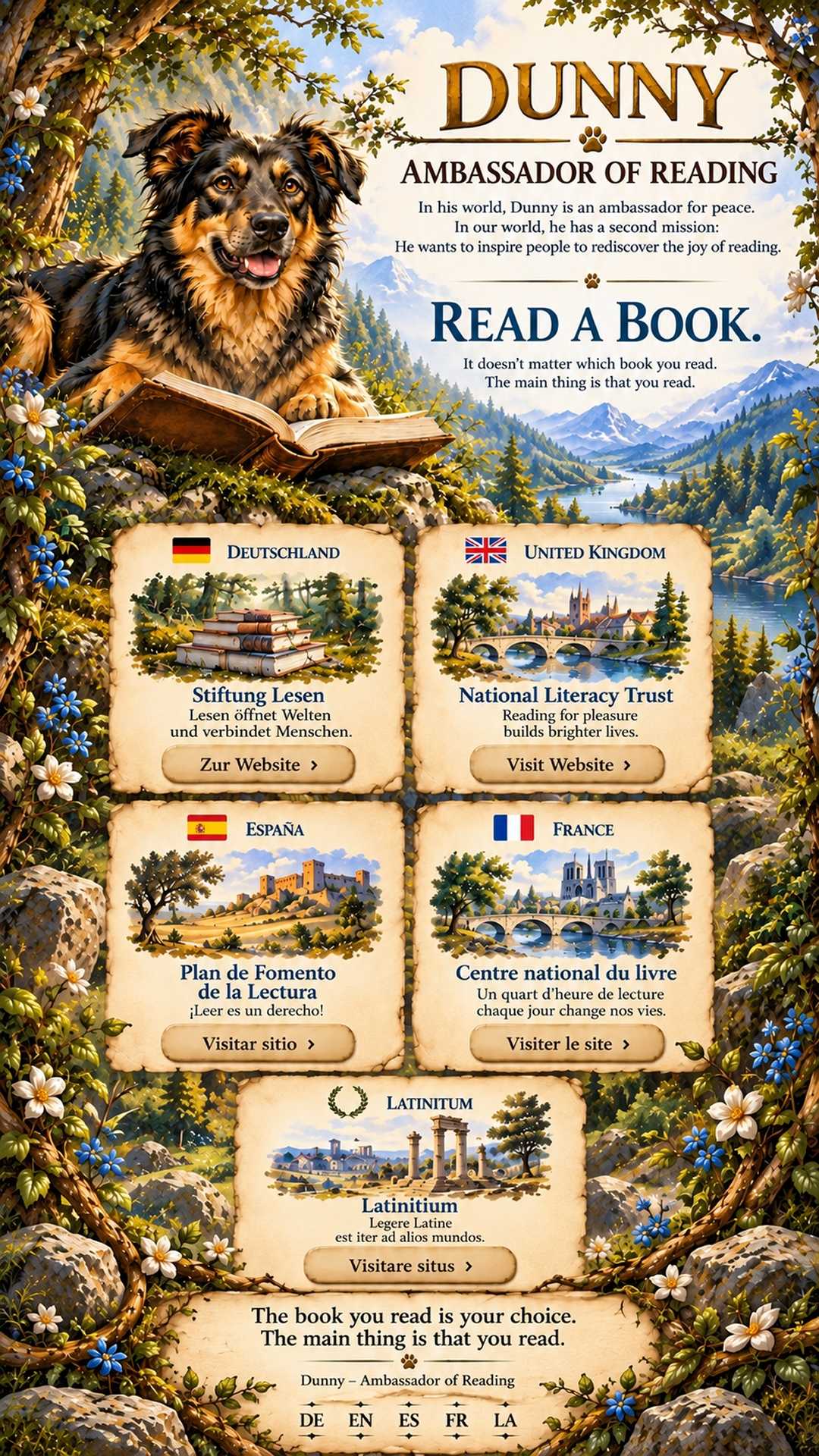
The Animals of Troyes - Reading Campaign 2026
Ray Adam © 2026
Ray Adam: It is entirely digital - ironically enough, you might say [ laughs ]. A campaign banner appears across my three websites, featuring Dunny as »Ambassador for Reading«. Click on it and you are taken to the campaign page for your own country. And Dunny does not sell you anything there. He says: »Read a book. It doesn't matter which book you read. What matters is that you read.«
SPT: A book author sending visitors off to read other people's books?
Ray Adam: Of course. It would be rather dishonest to launch a campaign for reading that was really nothing more than an advertisement for my own books. I genuinely do not care whether someone then reads »The Animals of Troyes«, Harry Potter, Goethe, a crime novel or a book about model railways. They should find a book that interests them - and read it.
SPT: Which is why the campaign page also points readers towards other organisations.
Ray Adam: Exactly. For each of the four modern languages in which »The Animals of Troyes« has appeared, I selected an established initiative or institution that promotes reading: in Germany the Stiftung Lesen [1], in the United Kingdom the National Literacy Trust [2], in Spain the state-run Plan de Fomento de la Lectura [3], and in France the Centre national du livre [4]. Their approaches differ, but the common purpose is the same: to bring people back to reading and to foster the pleasure of it.
SPT: And then there is Latin.
Ray Adam: Yes. Naturally there is no national Latin reading campaign comparable to those in Germany, France or Spain. So Dunny points readers to Latinitium. I particularly like that because it attempts something that fits our campaign very well: not merely analysing and translating Latin, but actually reading Latin texts and understanding them.
SPT: Are you working with any of these organisations?
Ray Adam: No, and I want to make that absolutely clear. There is no partnership, no sponsorship and no official collaboration. I point to their work because I believe their aims are worth supporting. Anyone whose interest in the subject is sparked by Dunny and who wants to know more can go directly from Dunny's campaign page to those organisations. We have provided the relevant links.
SPT: The Spanish reading plan, of all things, explicitly describes reading as contributing to a freer, more equal and more democratic society. Which brings us, at the end, straight back to your rather political starting point.
Ray Adam: Yes. And perhaps that is not so surprising. A democracy needs people who are capable of informing themselves. People who can follow a sustained argument, compare different claims and notice when things do not add up. People who do not merely understand what somebody is telling them, but can also ask themselves why they are being told it.
SPT: So reading, in your view, is a democratic skill?
Ray Adam: Reading for meaning certainly is. The ability to read and understand does not automatically make anyone sensible, nor does it guarantee that they will make the right decisions. But it gives them an important tool with which to make their own decisions. And that is precisely what matters in a democracy.
SPT: That is quite a journey for a sixteen-year-old canid from Troyes.
Ray Adam: [ laughs ] It is. Dunny originally only wanted to save his own world. Now he is apparently expected to get ours reading as well.
SPT: And if he succeeds?
Ray Adam: I wish him all the luck in the world - this wonderful world. He'll do it! Somewhere, one day, somebody will put their smartphone aside for a while, pick up a book - any book - and begin to read.
SPT: A real book?
Ray Adam: Yes. A real book.