


For decades, Western governments presented deregulation, privatization and economic liberalization as pragmatic reforms designed to increase efficiency, competitiveness and individual freedom. In reality, these policies transferred political authority from democratic institutions to increasingly autonomous market structures whose decisions now shape large parts of everyday life far beyond public control.
In much of postwar Europe, work once carried political meaning beyond wages alone. In Britain especially, the industrial worker occupied a central place in public life - not merely as labor, but as a social and political figure whose existence shaped parties, unions, journalism and political culture.
WORK WITHOUT SECURITY
Germany developed differently. The Federal Republic integrated labor into a highly organized economic system built on productivity, industrial discipline and social partnership. Workers were only afforded special protection in sectors where this protection also served economic stability.
A special moral or political position for workers in the sense of the British labor tradition never existed in Germany. German prosperity, often referred to as the »German economic miracle«, did not arise from collective political empowerment, but solely from top-down economic policies.
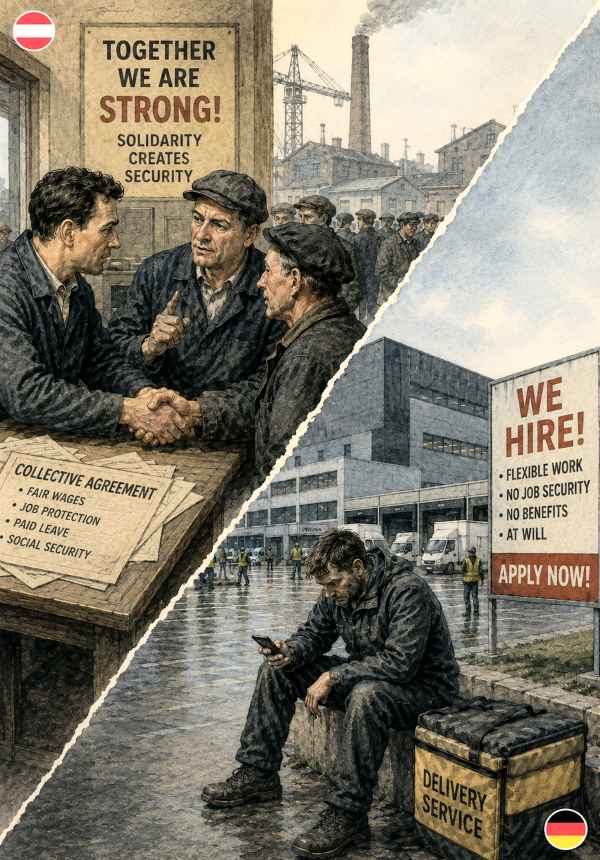
It is worthwhile at this point to take a look at post-war Austria. Completely unlike in Germany, collective bargaining agreements and the entire surrounding wage system became the most important component of the national political identity in the Second Republic.
To this day, entire workforces are protected by industry-wide agreements negotiated between unions and employers at the national level. Wages, working conditions and social protections were treated not merely as private contracts, but as elements of social stability. Up to the present day Austria treates collective bargaining not merely as an economic instrument, but as part of the institutional architecture of social stability.
THE BIG CHANGE
Beginning in the 1980s, the language of economic competition entered political life with growing force. Flexibility replaced stability. Competitiveness replaced solidarity. Labor increasingly ceased to exist as a political question and became an economic variable instead.
What followed was not the sudden destruction of social order, but something more profound: the normalization of insecurity.
Stable industrial employment gave way to fragmented labor markets, temporary contracts, subcontracting chains and permanent competitive pressure. Entire regions - once built around industrial production - entered long periods of structural decline. Nowhere became this more visible than in eastern Germany after reunification.
Helmut Kohl had promised »blossoming landscapes.« What many East Germans experienced instead was the liquidation of an entire economic world. Factories disappeared. Industrial regions collapsed. Collective structures dissolved almost overnight. Publicly owned industries built over generations were privatized, dismantled or sold at extraordinary speed. Millions of people did not merely lose employment, they lost historical continuity.
Much of eastern Germany entered the new market economy not as an equal partner, but rather as a region of 14 million people subjected to external economic restructuring. The consequences are still visible today – in deep political distrust, demographic decline, social alienation, and the profound political divide that continues to separate East and West Germany to the present day.
Western political elites often describe these developments as unfortunate side effects of modernization. But modernization for whom?
Across large parts of Europe, economic liberalization concentrated wealth, weakened labor structures and transformed social security into a question of market performance. The worker ceased to exist as a political subject and became part of a permanent system of economic adaptation instead.
In Britain, George Orwell once observed that modern industrial societies are based on a virtually invisible class system, the existence of which remains hidden - and this is a deliberate political strategy of the ruling class - precisely from those who operate at the top of this system and profit from the labor of the classes below them.
Jack London, too, described London's East End not as an exception to industrial civilization, but as one of its inevitable consequences. Lessons from these insights, gained long ago, have yet to be learned.
Today's Europe prefers to ignore reality. But behind the rhetoric of innovation, flexibility, and modernization, the old question has never disappeared: Who bears the social costs of the market economy, and who possesses the power to make decisions of this magnitude?
THE MARKET AS POLITICAL SYSTEM
The transformation of Western democracies did not begin with a conspiracy, nor with the sudden collapse of political institutions. It began with a new political philosophy that treated the market not merely as an economic mechanism, but as the superior organizing principle of society itself.
Few figures shaped this transformation more profoundly than the American economist Milton Friedman. Together with a growing generation of neoliberal thinkers, Friedman claimed that state intervention would distort economic efficiency, weaken individual freedom and prevent markets from regulating themselves. Deregulation, privatization and the unrestricted movement of capital became central political objectives across large parts of the Western world.
Ronald Reagan in the United States and Margaret Thatcher in Britain translated these ideas into political reality. Germany followed more cautiously, but it followed nonetheless.
What changed was larger than economic policy alone. Markets no longer operated within political systems. Politics increasingly operated within markets. Public infrastructure became investment opportunity.
Housing became financial asset. Labor became cost factor. Universities became competitive service providers. Even large parts of public administration adopted the language of efficiency, optimization and economic performance.
Entire governments began speaking less like political institutions than like the boards of directors of large corporations. The consequences reached far beyond economics.
Once political authority accepts the market as the primary mechanism of social organization, democratic institutions gradually lose the ability to define collective priorities independent of economic pressure. This transformation altered the internal structure of democratic societies.
Political decisions increasingly followed the logic of financial markets, international competitiveness and investor confidence. Governments continued to hold elections, pass laws and administer public systems. Yet their room for independent political action narrowed continuously under the pressure of globalized capital flows, multinational corporations and increasingly concentrated economic power.
The result was a paradox visible across much of the democratic world: states remained formally sovereign while losing practical control over many of the forces shaping everyday life. Citizens continued voting. But housing markets, energy prices, industrial production, digital infrastructure and large parts of public communication increasingly escaped democratic influence altogether. Politics did not disappear - it became administration within systems no longer fully controlled by political institutions themselves.
THE RETURN OF THE SOCIAL QUESTION
For decades, Western Europe believed it had solved the great social conflicts of industrial society. Rising prosperity, expanding middle classes and functioning welfare systems created the impression that poverty, insecurity and social instability belonged largely to the past. That confidence has begun to collapse.
Across large parts of Europe, ordinary life has become economically fragile again. Housing costs consume growing shares of household income. Energy prices fluctuate beyond political control. Food, transportation and healthcare place increasing pressure on families whose wages no longer keep pace with the cost of living.
In many cities, entire generations are being pushed out of the housing market altogether. The crisis extends far beyond inflation alone. Housing itself has been transformed into a financial asset class governed by investment logic rather than social necessity.
International capital flows entered urban real estate markets with enormous force. Apartments became speculative objects. Entire neighborhoods were reorganized around profitability.
Politicians largely accepted this change. Governments introduced subsidies, temporary rent controls, and half-hearted aid programs, but in doing so, they avoided the fundamental question: whether housing should even be allowed to function primarily as a market commodity.
The consequences are visible everywhere. Teachers, nurses, industrial workers and young families increasingly struggle to remain living in the cities whose economies depend on their labor. Social mobility weakens. Economic pressure enters everyday life with growing permanence. What once defined social crisis now defines normality.
THE CRISIS OF DEMOCRATIC BELONGING
Political systems rarely collapse because citizens suddenly reject democracy itself. More often, democratic legitimacy erodes when large parts of society no longer believe political institutions are capable of shaping material reality in meaningful ways. This erosion has become increasingly visible across Europe.
Migration debates illustrate the problem with particular intensity. Germany remains economically dependent on immigration while simultaneously struggling to maintain social cohesion under conditions of housing shortages, overstretched public services and growing economic insecurity. The result is a political climate dominated by contradiction.
While governments theorize about humanitarian responsibility, many municipalities struggle with practical limits in schools, housing and local administration.
Economic elites demand labor migration while large parts of the population experience declining stability in their own lives. Public debate increasingly oscillates between moral absolutism and political resentment, leaving little room for realistic discussion. Under such conditions, polarization becomes inevitable.
The rise of the AfD in Germany cannot be understood merely as a product of extremism or propaganda. It reflects a deeper political fracture produced by decades of social dislocation, economic insecurity and growing distrust toward institutions increasingly perceived as distant from everyday reality. Nowhere is this more visible than in eastern Germany.
After reunification, 14 millions of East Germans experienced not simply political transition, but the destruction of an entire social and economic order.
Public industries disappeared. Regional identities collapsed. Long-term unemployment spread through entire communities. Many people watched their previous lives reduced to economic inefficiency within a market system they neither shaped nor controlled. The political consequences continue to shape Germany decades later.
Much of contemporary democratic discourse treats such developments primarily as communication problems requiring better education, stronger media literacy or intensified constitutional awareness. But political alienation rarely begins with ideology alone.
It begins when citizens lose confidence that democratic institutions still possess authority over the economic structures shaping their existence.
THE RETREAT OF THE STATE
The consequences of this transformation now extend beyond domestic politics into the structure of state power itself. Across Europe, governments increasingly confront crises they can no longer fully control:
• global capital movements
• energy dependency
• digital monopolies
• migration pressures
• geopolitical fragmentation
• growing military insecurity.
The war in Ukraine exposed the strategic vulnerability of a whole continent that spent decades subordinating long-term political planning to economic efficiency.
Germany in particular built much of its industrial stability on assumptions of permanent globalization, cheap energy and expanding international trade.
Those assumptions no longer hold. European states now attempt to rebuild military capacity, secure supply chains, regain industrial sovereignty and reduce external dependencies — all while operating within economic systems largely shaped by global market forces beyond national control. The contradiction defines contemporary Europe.
States remain formally powerful, yet increasingly reactive. Governments continue to announce programs, summits and strategic initiatives while the structural forces shaping modern economies operate on scales far exceeding traditional democratic institutions. The crisis of democratic societies therefore extends far beyond economics, it reaches the question of political sovereignty itself.
Can democratic states still govern economies organized around transnational markets, concentrated capital and permanent global competition? Or has politics gradually and almost imperceptibly assumed a much more limited role: managing the social consequences of decisions that are made elsewhere?

