

The Real History Behind Shadow Powers
The Shadow Powers trilogy blends fiction with real historical events. Many scenes are inspired by real people, places and developments — revealing how closely truth and imagination often intertwine.
REALITY
The assassination in Sarajevo at the end of June 1914 marks one of those historical tipping points where political instability suddenly escalates. The murder of Archduke Franz Ferdinand of Habsburg acted as a catalyst for an already highly strained system of competing great powers. In retrospect, the path to World War I appears structurally predetermined: alliances, militarization and imperial rivalry had created an explosive constellation that could be ignited by a single event.

POWER AND WAR
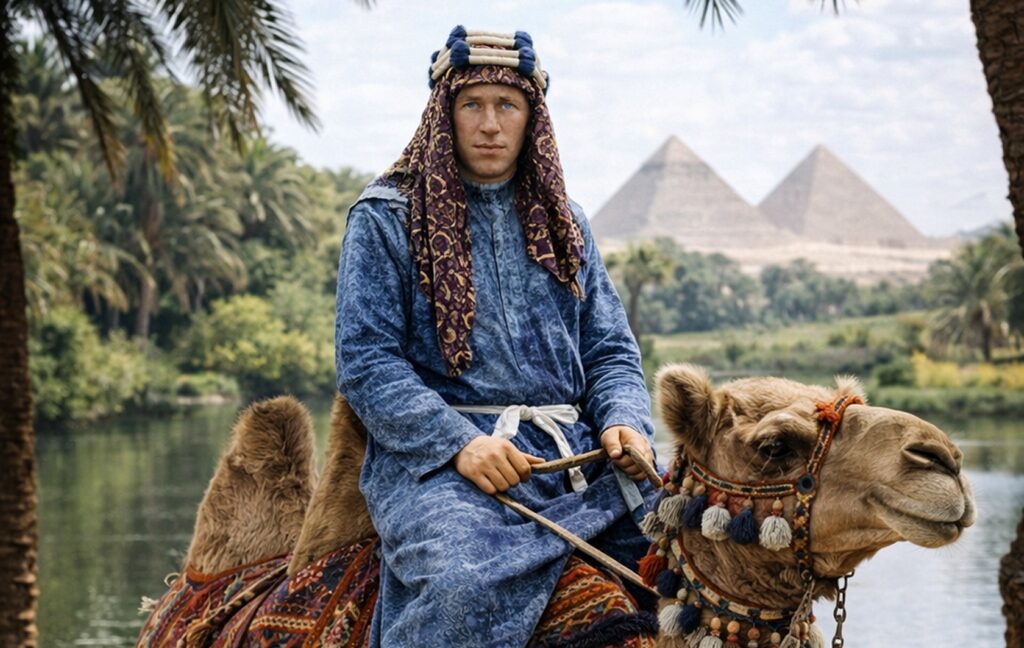
War does not manifest itself solely on the battlefield, but equally through strategy, influence and hidden operations — often with longer-lasting effects than military victories. Figures such as Lawrence of Arabia demonstrate how individuals can reshape entire regions. By coordinating local forces and mediating geopolitical interests, he connected military action with political influence. Such examples show that war has always been a field of indirect power, where individuals can initiate far-reaching transformations.
PROGRESS AND ILLUSION
The airship Hindenburg embodies the ambivalence of an era that viewed technological progress as an almost limitless expansion of human control. As a symbol of modern engineering, it suggested dominance over nature — yet it was also a prestige project reserved primarily for social elites. The catastrophe of the Hindenburg disaster exposed the fragility of this belief in progress. It revealed the inherent risks hidden behind the promise of technological mastery. Thus, progress appears less as a linear gain of control, and more as a contradictory process that produces illusion and vulnerability at the same time.

THE EDGE OF THE UNKNOWN

The mass breeding of so-called knockout mice reveals the darker side of biotechnological progress — where economic usability often outweighs ethical reflection. Living beings are reduced to research objects, their existence serving primarily to generate data and profit. Under the justification of biomedical advancement, the boundaries between research and systematic exploitation begin to blur. Progress no longer appears purely as a humanistic endeavor, but as a mechanism willing to accept suffering in exchange for results.
HISTORY AS WE DO NOT SEE IT
The Shadow Powers trilogy unfolds at the boundary between reality and fiction. Set against the backdrop of a world on the brink — from the tensions preceding World War I to the present day — it reveals a layered narrative that casts familiar events in a new light. Its strength lies in the balance between historical accuracy and speculative expansion. The novels do not claim absolute truth, but consciously open up possibilities and perspectives.
The dark, almost dystopian atmosphere gives history an unsettling depth, where themes such as power, ideology and hidden influences intertwine. This raises a central question: Are visible decisions truly what shape our world — or are unseen forces at work behind them? By combining historical reality with supernatural elements and time travel, Shadow Powers offers a new perspective on the evolution of our world.
Archive Reference: XF07
Dieser historische Fantasy-Roman verbindet Weltkriege, Zeitreisen zwischen Mittelalter und Gegenwart sowie die verborgene Wirkung geheimer Mächte auf die Weltgeschichte.
Since corrupt people unite amongst themselves to constitute
a force, then honest people must do the same.
© 2026 Ray Adam · All rights reserved