


As early as 2016, J. D. Vance publicly warned about Donald Trump, drawing stark historical comparisons. A few years later, he is standing at his side.
This is not an exception. It is a pattern.
Convictions become flexible once power becomes tangible. And it is precisely in this political climate that Trump was able not only to become president, but to return to office.
The State as Negotiable Asset
Trump has never claimed to be a traditional politician. He presents himself as a businessman. The problem begins where this logic is transferred to politics.
Politics is not a market. International relations are not construction contracts. Diplomacy is not a zero-sum game. And yet, this model is applied:
Everything is negotiable.
Everything is a deal.
Everything is reduced to short-term gain.
Long-term stability loses relevance.
Reliability becomes relative.
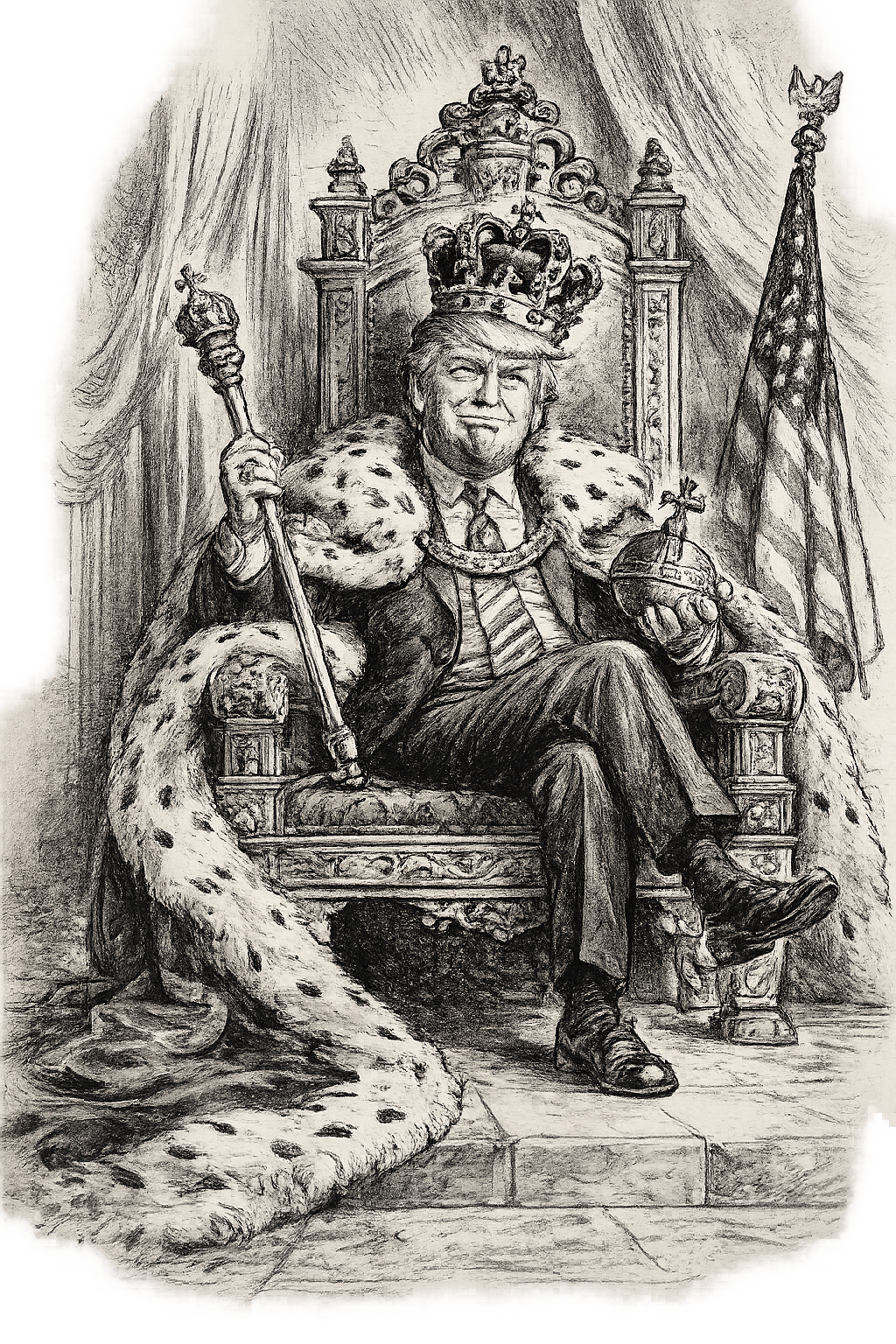
Cartoon: President – or symbol of a shifting order?
The Erosion of International Order
For decades, the United States was a central pillar of global stability: alliances, treaties, international institutions – a network built on cooperation.
Under Trump, this network is visibly strained. Agreements are questioned, partnerships recalculated, institutions weakened.
What remains is a foreign policy driven less by shared rules than by immediate interests.
The Logic of Short-Term Advantage
The language of »deals« sounds pragmatic, efficient, goal-oriented. Yet therein lies the problem.
International politics does not function like business. It relies on trust, predictability and long-term cooperation.
Replacing these foundations with short-term advantage alters the system – not only gradually, but fundamentally.
Experience Replaced
Traditionally, governments rely on expertise: diplomats, specialists, institutions.
Under Trump, this approach shifts. Complex political processes are simplified, experience loses weight, personal loyalty gains importance.
This may work in the short term. In the long term, it erodes the ability to manage complex global dynamics.
Trust Is Not a Resource
Political decisions have a defining characteristic: they endure. Trust, once damaged, cannot be easily restored. International relations react sensitively to unpredictability. Those who question agreements today will be trusted less tomorrow.
An Uncomfortable Parallel
The term »rogue state« was once used to describe countries that disregard international rules and withdraw from global cooperation.
The parallel is evident.
A policy that relativises treaties, weakens institutions and replaces cooperation with confrontation follows the same pattern.
Trump as Symptom
Donald Trump is not an anomaly. He is the product of a system that values economic success over political experience, performance over substance, and short-term gain over long-term stability.
He did not invent this logic. But he made it visible.
Conclusion: A System Without Correction
What remains is more than a presidency. It is a condition.
A system that shifts its own boundaries without openly acknowledging it.
When politics becomes business practice, when power becomes an end in itself, when rules apply only as long as they are useful, the change extends beyond a single country.
It reshapes the environment in which it operates.
And that is precisely what makes this development so consequential.