


One of the unspoken assumptions of post-war Germany is that the state between 1933 and 1945 was distorted, but never fundamentally abolished. It is a convenient assumption. It allows continuity where rupture would have been necessary. But what if it is wrong? What if those twelve years did not merely corrupt the law — but dissolved its very foundation?
Franz Neumann’s »Behemoth: The Structure and Practice of National Socialism« remains one of the most significant, and yet least widely engaged, analyses of the Third Reich.
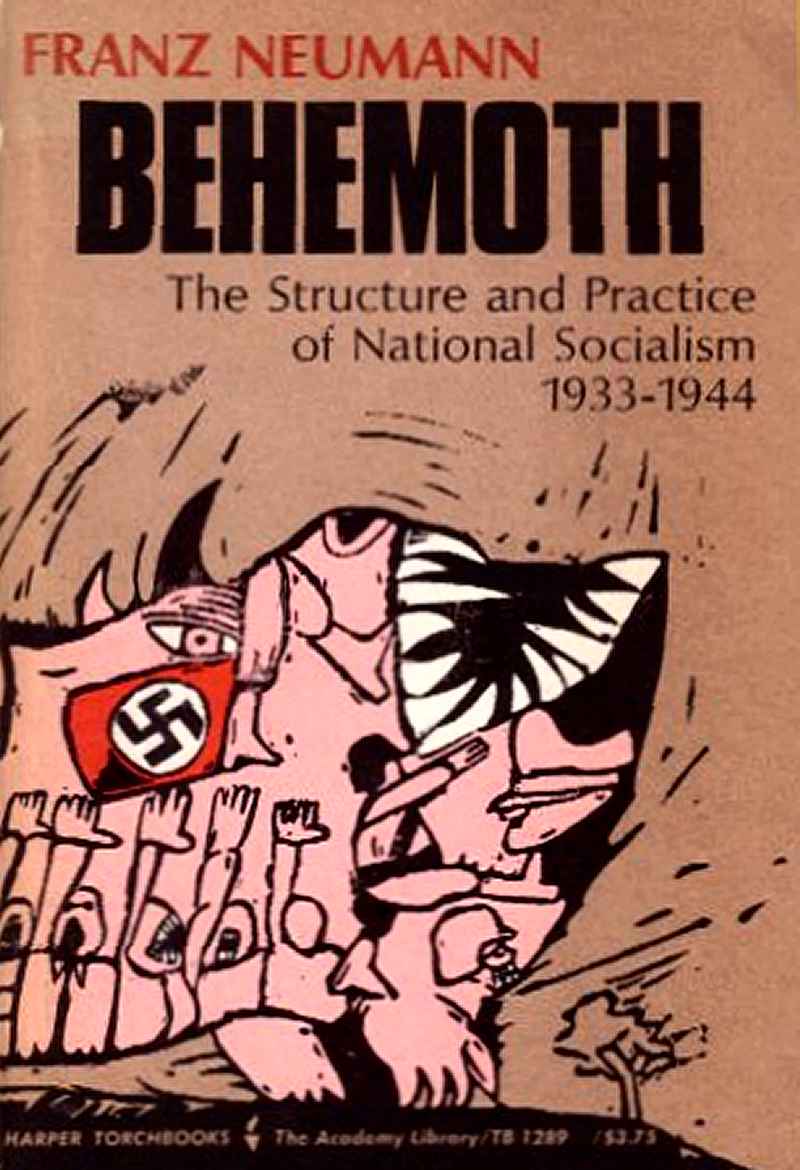
First published in the United States in 1942 and 1944, and only later made available in Germany, Neumann described the Nazi system not as a state in any classical sense, but as a network of competing power structures.
Bureaucracy, party, military, and industry did not form a coherent system, but a constellation of overlapping authorities. Power did not derive from law — law was subordinated to power.
No state in the classical sense
If one takes Neumann seriously and follows his reasoning to its logical conclusion, a radical question emerges: did a german state, in the legal sense, exist in Germany between 1933 and 1945 at all?
With Hitler’s appointment on 30 January 1933 and the gradual dismantling of institutional constraints, what remained of the state was hollowed out from within. Norms ceased to bind universally. Law became selective. Authority gave way to arbitrariness.
The state did not disappear overnight. It was dismantled deliberately — piece by piece, decision by decision. What remained was not order, but its shell: an apparatus that called itself a state, without any longer being one.
Society as an instrument
Germany under National Socialism remained a class society. A ruling elite deployed administrative, economic, and ideological structures to control and exploit the population.
What was presented as a »people’s community« functioned, in practice, as a system of hierarchy and dependency.
The erosion of law
When law no longer derives from legitimacy but from power, it ceases to be law in any meaningful sense. It becomes form without substance — a façade behind which arbitrariness is organised. The central question is therefore not whether law existed between 1933 and 1945, but whether what was called law deserved the name at all. What emerged was not a legal order, but the administration of injustice.
The question, then, is unavoidable: can the legal acts carried out between 1933 and 1945 be understood as law — or must they be recognised as formalised injustice?
Property transfers, marriages, judicial decisions — all took place within a system that had forfeited its normative foundation.
The absence of consequence
With the collapse of the regime in 1945, its structures did not simply vanish. Their consequences remained. A genuine legal reckoning would have required more than political condemnation. It would have meant questioning the validity of the realities created during those twelve years. That did not happen. Instead, continuity prevailed over rupture. Stability over consequence. The result was not a clean break, but the managed absorption of what had been.
Whether this was necessity or decision remains open. The essential questions are not new. They have simply never been answered consistently.
What happens to a society that doesn't fully reject a system of injustice, but instead integrates parts of it into its own order?
The answers are uncomfortable, but precisely for that reason, these questions must be asked relentlessly - even today, after so many years.
The real problem lies not in the past itself, but in the uncritical way we accept things without question.