


What is a state? Most answers begin with institutions, borders, or power. This book starts earlier and more fundamentally.
The »Just State« does not treat the state as a given, but as the result of a problem: how to organise human coexistence in a stable way when individual freedom inevitably leads to conflict. From this premise, the text develops an analysis that deliberately moves away from familiar political categories.
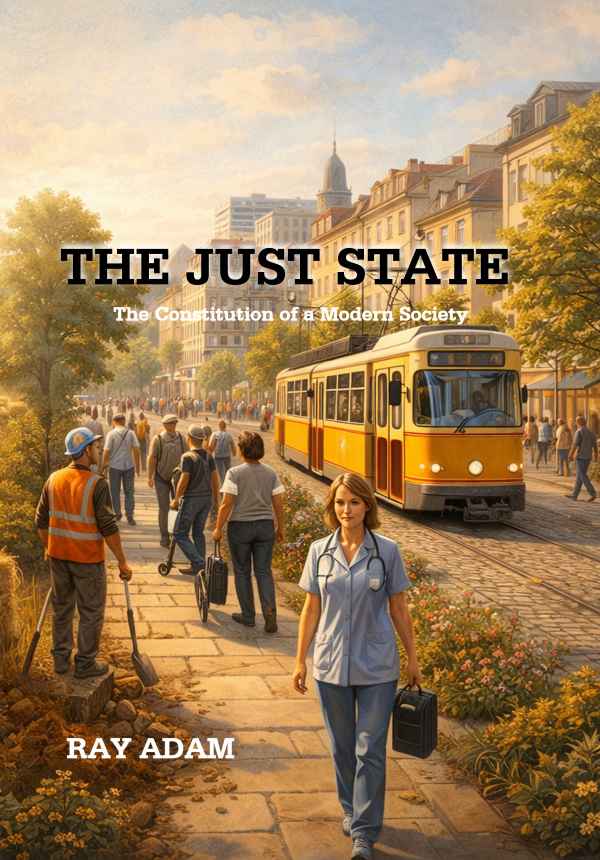
70 pages · 8 color illustrations · €10.80
It does not follow a conventional theory, but its own internal logic. Beginning with the simplest forms of human interaction, it traces the development from order to power, from rule to revolution, and ultimately to the competing systems of the twentieth century.
Moral judgement is largely absent. Instead, the state is described functionally, as an instrument that always serves a purpose, but is never neutral.
Particularly striking is the comparison between Western and socialist systems, which is not conducted at the level of ideology, but through everyday life. Differences emerge not in programmes, but in lived reality: mobility, work, housing, and social structure. This perspective gives the text a clarity that is rarely found in political writing.
CONSTITUTION OF THE JUST STATE
In its final section, the book moves beyond analysis. It presents a complete constitutional framework, developed as a direct consequence of the preceding argument. What emerges is the outline of a state oriented not toward power, but toward the equalisation of living conditions and, ultimately, toward its own disappearance.
Whether such a model is realistic remains an open question. The book does not claim immediate applicability. Its strength lies elsewhere: it compels the reader to reconsider the state not as a fixed structure, but as something that can be shaped. That, in the end, is its central effect.
The Just State is neither a political programme nor a theoretical manual. It is a conceptual proposal and an invitation to think about a question that is rarely asked:
Who owns the state, and who determines the conditions of life?
