


The 1911 illustration of the »pyramid of the capitalist system« no longer appears as a relic of agitational exaggeration, but as an eerily accurate X-ray of our present. What was once dismissed as polemic now reads like diagnosis: power accumulates at the top, while the many carry the weight below. In between lies nothing but the machinery that keeps it in place.
Has anything truly changed – or have we simply grown accustomed to looking away?
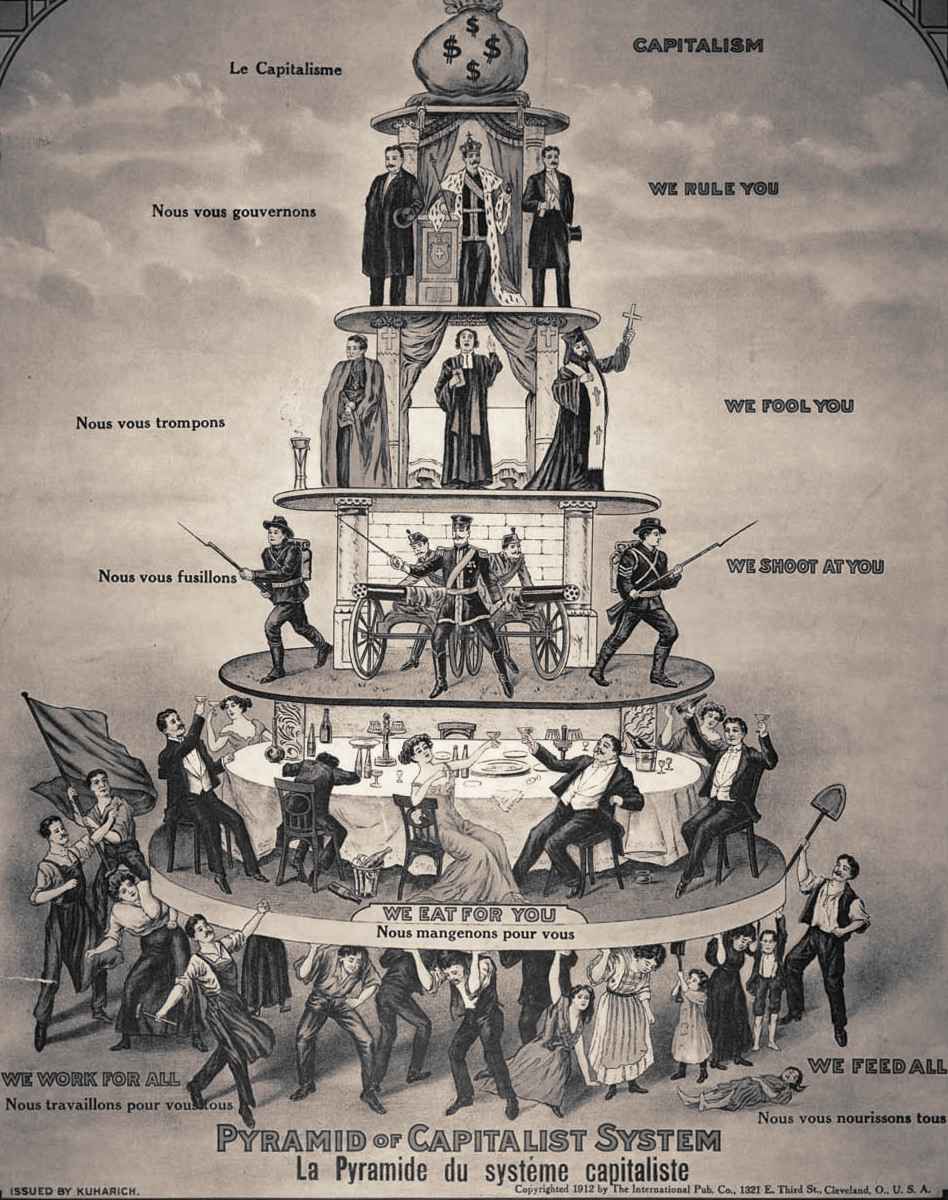
Structure of inequality
The pyramid still stands. It is taller now, heavier, more refined, and increasingly sealed off at the top. Its stability is no accident. It is the product of a system that does not merely produce inequality, but organises it, justifies it, and ensures its continuity.
The Great Myth of Upward Mobility
For more than a century, we have been told that capitalism is a promise: work hard, and you will rise. It is one of the most successful narratives of modernity – and one of its most persistent illusions.
In Germany, the wealthiest one percent owns roughly a third of all assets, while the bottom half holds almost nothing of measurable significance. In the United States, the top one percent controls between 35 and 40 percent of total wealth, while millions live without financial reserves. A single medical emergency is often enough to trigger social collapse.
Globally, one to two percent of humanity owns more than half of all wealth. Is this still a system of opportunity – or one of inheritance?
Those at the top remain there. Those at the bottom rarely leave. Social mobility, once the ideological core of capitalism, is becoming a statistical exception. And yet the narrative endures – perhaps precisely because it must.
Ownership and the Quiet Dispossession
The defining question of our time is no longer who works, but who owns. Ownership is power – over housing, over production, over the future itself.
In many Western societies, between 80 and 90 percent of corporate assets are controlled by a small minority, often less than ten percent of the population. Housing markets reflect the same logic: for many, a struggle for affordability; for a few, a source of secure and growing returns.
While wealth accumulates at the top, erosion takes place below. Rising rents, stagnant wages, precarious employment – these are not isolated trends. They are structural.
Those who own extract. Those who do not pay. And those who pay uphold a system that insists there is no alternative.
Subsidised Inequality
The logic of the pyramid becomes particularly stark where it disguises itself as progress. Public subsidies – for instance, in the name of green transition – are framed as necessity. But who benefits?
High-end electric vehicles remain the preserve of those already in possession of capital. The subsidies, however, are financed collectively – often by those who will never be able to afford such products.
The pattern is familiar. Public funds sustain consumption, stabilise industries, and ultimately reinforce existing hierarchies. Is this support – or redistribution from the many to the few, masked as rational policy?
Globalisation and Invisible Exploitation
Globalisation has not eliminated inequality. It has displaced it – and rendered it less visible. Production has been relocated to regions where labour conditions would be considered unacceptable in wealthier societies, were they not happening elsewhere.
Low wages, minimal protection, excessive working hours: the cost of cheap goods is paid out of sight.
But the consequences return. Industries collapse, regions decline, biographies fracture. A new class emerges: those no longer needed by the system. Not unwilling – simply unnecessary.
Redundant. Few words capture the brutality of modern economic logic more precisely.
Social Erosion
The effects are visible. Societies fragment: between owners and renters, security and precarity, winners and those left behind.
The so-called middle is no longer stable ground, but contested territory.
In the United States, this process is further advanced. A healthcare system tied to income transforms illness into financial risk. To fall sick is to risk ruin. An anomaly – or a preview?
The New Masters
At the apex stand figures such as Elon Musk, Mark Zuckerberg, and Peter Thiel. They represent a new concentration of power – economic, technological, cultural, and political at once.
Their platforms structure communication, their companies shape futures, their decisions influence entire societies. And yet a simple question remains unanswered: how much is enough? When wealth reaches levels that cannot be meaningfully consumed even across generations, what does that say about the system that enables it?
Progress or Illusion?
Capitalism has delivered progress. That is beyond dispute. The question is: for whom? If innovation primarily benefits those who already possess capital, then progress ceases to be collective. It becomes selective.
The old pyramid captures this reality with brutal clarity. It shows not only who stands at the top, but who remains below – and why. Perhaps its greatest strength lies in its refusal to answer. Instead, it forces us to ask: Is this order truly without alternative – or does it persist only because we have ceased to question it?
The pyramid still stands. The real question is not whether it exists, but how long it will endure.