



Vienna, 1976
It is the height of the Cold War. At the heart of Europe lies neutral Austria - right between the power blocs of NATO and the Warsaw Pact. Nuclear missiles stand ready on both sides, each aimed at the other. Fourteen years earlier, things had nearly gone terribly wrong. Then the SALT agreements promised a relaxation of tensions. Yet people still feel the danger - anyone who lived through the Cuban Missile Crisis as a young person will never forget those days. They know that the world could be destroyed within hours - by either side.
Domestically, Austria is doing well: Under Chancellor Bruno Kreisky's government, the country is experiencing far-reaching social reforms and economic growth. A modest degree of prosperity is reaching broad sections of the population.
The environmental movement is emerging and gathering momentum. Austria's first nuclear power plant, Zwentendorf, is about to begin operating, and there are no satisfactory answers to questions about the risks of nuclear energy. Many young people oppose nuclear power. No permanently proven repository for highly radioactive waste exists - anywhere in the world.
In Vienna lives the thirty-year-old singer-songwriter Georg Danzer. His new single has just arrived - a Christmas song, and that is what the single is about: »Wie woa Weihnachten?« (»What Was Christmas Like?«)

A song that packs a punch, because it captures the profound fears of an entire generation. Young people who, during the Cuban Missile Crisis in 1962, had their whole lives ahead of them, yet had to fear every day that it might be their last.
Such memories remain - such memories never go away.
Hamburg, 1976
In Schleswig-Holstein, construction begins on the Brokdorf nuclear power plant. Outraged citizens organize protests against it. The anti-nuclear movement spreads across Germany. In November, German police brutally confront demonstrators with water cannons, tear gas and batons. More than 150 people are injured.
Number-one hits include »Money, Money, Money« by ABBA, »Daddy Cool« by Boney M. and »Ein Bett im Kornfeld« by Jürgen Drews. Otherwise: all quiet on the Western Front.
At the time I live in Quickborn, near Hamburg. I am twenty-two and a student. A yellow sun is stuck to my old Volkswagen Beetle:

Twice my foolish father angrily tears the sticker off. Three times I stick it back on.
In 1962 I was still too young to understand the connections behind the Cuban Missile Crisis. So I do not know the fears of those ten years older than me, but I do not need to - simply knowing that Germany lies between the two power blocs and would be the first victim in a conflict is quite enough to give me sleepless nights.
And then I hear Georg Danzer's song on the radio: »Wie woa Weihnachten?«
The song tells a story, but not about Christmas in 1976. It takes place in a not-too-distant future in which a great war has devastated the world. People live underground, having retreated into catacombs because the world above is no longer habitable.
A child grows up there, unfamiliar with many things we take for granted. Snow. Stars. Christmas trees. Christmas itself. The boy meets a hundred-year-old man who can still remember these things, and he begins to ask questions.
What was Christmas like?
What is snow?
What do stars look like?
What does bliss mean?
The old man tries to answer him, and the longer he speaks, the clearer it becomes that he is not merely describing a tradition from the past; he is telling the story of a lost world.
A Child Who Has Never Seen Snow
Just imagine what that means! A child does not know snow because he has never had a chance to see it! The world in which snow falls exists for this child only in an old man's memories.
He has never seen stars either, and that thought may be even more terrifying, because the stars have not disappeared - they are still where they have been for billions of years. People simply cannot see them anymore because they must live underground.
The very humanity that once dreamed of flying to the stars has devoted itself so thoroughly to its own destruction that its children can no longer even look at the sky!
The old man tells his story. He remembers a Christmas tree, candles, lights and people singing together. He remembers snow and a time when Christmas meant joy to him. And he remembers the song of the silent, holy night.
What a strange memory! A silent night. A holy night. Peace. Safety. People coming together - and all of it recounted by a man who has lived underground for many years because human beings destroyed their world in a war.
For centuries Christianity has told of a child whose birth was meant to proclaim hope and peace. And at the same time, people who invoke that message develop weapons with which they can annihilate one another.
Scientific achievements grow ever greater, weapons ever more effective, and the capacity for destruction keeps increasing. But our ability to live peacefully with one another is clearly not keeping pace.
And so, in the end, all that remains of the silent night is a memory.
What Is Bliss?
One of the child's questions particularly troubles me: He wants to know what bliss means. A difficult question, because how do you explain a feeling to someone who has never experienced it?
How do you explain what it means to feel safe to someone who has known only fear?
How do you explain peace to someone whose entire world consists of the consequences of war?
How do you explain freedom to someone who must spend his life underground?
How do you explain hope to someone whose future consists of nothing but the desire somehow to survive?
Today we possess an immense body of knowledge about the world. We can analyse the composition of distant stars, decode the human genome and build machines that perform tasks which once required entire teams of people.
But what good is all that knowledge to a child who does not know what happiness means?
It is precisely here that we see how little technological progress alone tells us about the state of a civilization. A society can be highly advanced scientifically and still fail its people. It can possess the means to improve its citizens' lives and instead use those means for destruction.
It can know everything about how stars are formed and rob its children of the sight of a starry sky. And it can explain the concept of bliss in a thousand books without enabling its people to lead happy lives.
The Old Man
The old man in Danzer's song is a hundred years old. He has survived the catastrophe, and that is quite an achievement in itself. But is it also a success?
What does survival mean when everything that makes life worth living has vanished? When all you can do is tell children what the world once looked like? When memories of snow, light and Christmas become more precious than all the technological achievements of a lost civilization?
When a person dies, they leave something behind: perhaps a house, perhaps money, perhaps debts, perhaps books, pictures or personal memories. And sometimes they leave nothing but the consequences of their decisions.
Societies that have perished leave things behind too: laws, institutions, scientific discoveries, works of art, roads, bridges, schools and hospitals - but also ruined landscapes, poisoned waters, radioactive waste, debts and political conflicts whose causes no one understands anymore.
The people who must inherit these legacies never chose them. They are born into this sorrowful inheritance.
And therein lies the moral problem:
What gives us the right to destroy the opportunities for life of future generations?
What gives us the right to consume resources that cannot be replaced?
What gives us the right to leave behind an environment in which our children and grandchildren can live only under increasingly difficult conditions?
What gives us the right to pretend that the consequences of our actions are none of our concern?
People tend to pass responsibility along until no one is responsible anymore. But the children who will later have to live in the catacombs cannot pass it on. They must bear the consequences.
The Christmas Story
A child is born, and with that child comes the hope of peace and a different way for human beings to live together.
Almost two thousand years later, humanity possesses weapons capable of destroying large parts of its own civilization - and at the same time it has the ability to understand what those weapons will do.
That does not make matters better, however. It makes them worse, because we cannot claim that we did not know.
Humanity has long known what an atomic bomb does. We have seen the images from Hiroshima and Nagasaki, and we know that a major nuclear war would not only kill millions of people immediately but also devastate living conditions across the entire planet, far beyond the areas attacked.
And yet these weapons still exist - even fifty years after Danzer's Christmas song!
And yet nuclear weapons are still being modernized today. And yet threats are still made to use them.
It beggars belief - even in 2026 the Pentagon is reviewing what role lower-yield nuclear weapons might play in future wars! As if nuclear annihilation could be divided into convenient little portions!
At Christmas, humanity celebrates the birth of a child as a symbol of hope while keeping at the ready the means to rob the children of the future of that very hope.
This is not a contradiction that can be made to disappear with a particularly solemn Christmas service. It is a contradiction that exists in our minds and therefore demands that we think and act - and do so now!
There is one final thought in Danzer's story. The old man hopes that perhaps one day people will be able to return to the surface. That the world will recover. That one day there might be Christmas again.
It is a small hope. No triumphant vision, no conquest, no technological miracle - merely the thought that someday human beings might once again live beneath an open sky.
Perhaps that is the saddest moment in the entire song, because what seems perfectly ordinary to us becomes the greatest happiness imaginable for the people of that future:
Seeing the sky - experiencing snow - gazing at stars - coming together with other people - celebrating a festival.
Things for which we need no technology whatsoever. Only humanity. All we have to do is make sure they are still possible tomorrow.
Northern Germany, 2026
Fifty years have passed since Georg Danzer's song - a human lifetime.
Today I am an old man myself. I do not know how much time I have left, but the days of new beginnings are long gone. I was never a member of any political party. I always trusted that people of my generation »would sort things out« - after all, we had once shared the same goal: to do better than the generations before us.
Only after I retire do I begin to look more closely again - and what I see makes me shudder.
Now, at the age of seventy-two, I bitterly reproach myself for never having become seriously involved in politics, although I could have done so. As a political person, I have failed in many respects throughout my life, and that weighs heavily on me.
In 1976 I could never have imagined leaving my children and grandchildren a world that looks the way it does today.
After all, my generation knew everything.
After all, my generation had the ability to do everything.
Politicians and business executives want us to believe that we still have plenty of time to solve the problems of our world. That is nothing but brazen reassurance. Anyone who steps outside in summer and wonders whether the weather is still what it was in childhood can see that our living conditions have already changed noticeably.
Catacombs? We no longer need them - fifty years after Danzer. Our catacombs exist in our heads; they are the reality of the present:
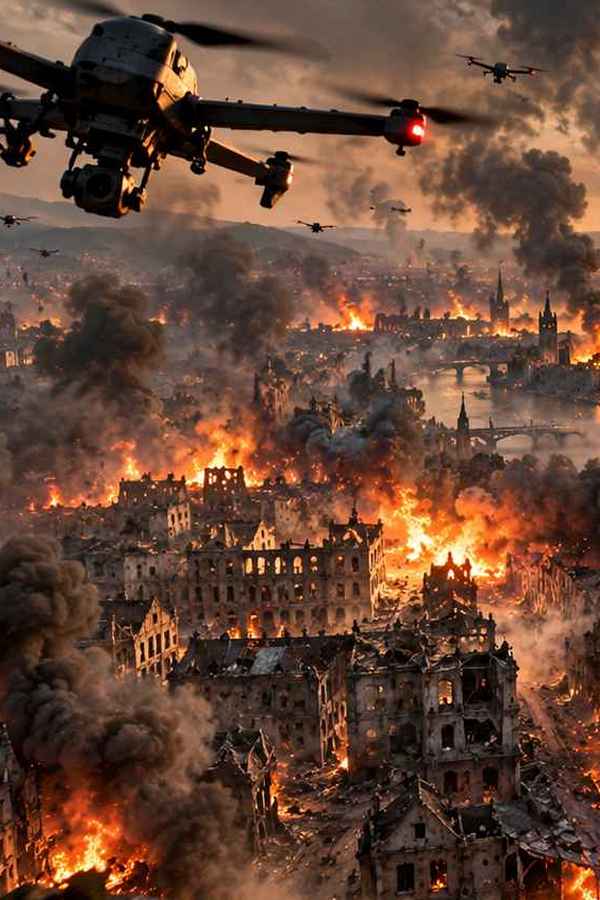
• A devastating war in Ukraine, begun by Russia with its full-scale invasion. We are already in the fifth year of the war. [1]
• A genocide against Palestinians in the Gaza Strip, which the United Nations Independent International Commission of Inquiry attributes to Israel's actions. [2]
• A senile US president who is ruining his own country in his pompous self-absorption. [3]
What more will it take for us to see where this road leads? Far too late in life, I realized that personal responsibility is not something you assume once and then possess forever. You have to fight for it anew every day and actually live up to it.
That is why I now run the SHADOW POWERS TIMES. At seventy-two, I can no longer bring about major political changes, but I can still write. At least one article every month, in which I try to inform, reveal connections and encourage people to think.
I want to continue doing that for as long as I live. I hope I still have plenty of time. For there is one thing I have come to understand:
It is not enough to hope that others will put the world right.
Responsibility cannot be delegated.
And it is never too late to take responsibility, but always too soon to stop. In the end, only one realization remains, and it is my Christmas message for 2026:
Dear God!
We knew everything, we were capable of everything, but we understood nothing.
In the stillness of the Holy Night, You reveal Your great mercy.
Fill our wonderful world with Your peace and Your light!
Amen